History
Explore the story behind Traditional Wing Chun, from its origins in southern China to the development of our club and the lineage that continues to shape our training today.
Our History
Myself and Frank both started training in the early seventies, under Instructor Peter Pete, in a run down building in Clacton. We worked our way through the modified system of wing chun, up to the instructors grade. When we had learnt all we could from Peter, he told us we should then train under master Derek Jones, which we did. We worked our way up through the traditional system, testing our art out in other clubs along the way. We were also the first students to undertake the 100 days iron palm training. During our time with Derek, we were also the first students to start teaching his system.
Master Frank Roach
I joined Pete's club because I was always a fan of Bruce lee, and wanted to do wing chun. As I was walking along the road in Clacton one day, and saw an advert in a laundrette for ving tsun, I had herd of wing chun but not ving tsun, and I stood for a moment and thought are these the same thing, the same art, so I thought I should go along and have a look. So I walked down the road to number 47 Pallister Road, went round the corner to this dingy looking place, it was very dark, if you didn’t know the area you might be very wary, so I went to this door and up these wooden stairs, it was quite eerily and I could hear the banging coming from up stairs and the movement, so I went up stairs, I got to the door put my hand to the handle and paused for a moment, I could hear people training, so I opened the door and there it was ving tsun, people were training really hard, not killing themselves but training really hard, and what they were doing was a straight punch which was just what I was looking for.
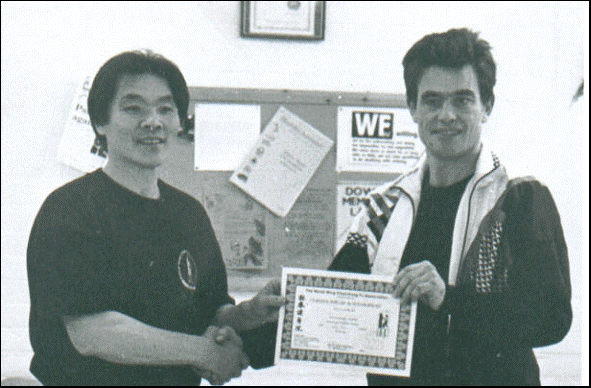
Master Mark Clark
I started training in Wing Chun Kung Fu in 1979, then under the guidance of Peter Pete who had himself trained under Grandmaster Victor Kan of Fulham, London. Grandmaster Kan was taught Wing Chun Kung Fu by none other than Grandmaster Yip Man in China.
Yip Man's name became well known in the seventies as the man who taught the famous martial arts star Bruce Lee. Bruce Lee became a legend on the screen due to his explosive ability.
In 1986 I reached my instructor grade in modified Wing Chun also at this time Peter Pete left England. This was the time that I started training in Traditional Wing Chun Kung Fu under the late Master Derek Jones from London. I used to travel up to London every week for training session's with Master Derek Jones until I attained my Master Grade.
Before becoming involved in Wing Chun Kung Fu, I studied boxing, Wado Ryu and Zenki Ryu Karate for a number of years.
The History of Wing Chun
Wing Chun is the name of a martial art system developed approximately 300 years ago in southern China. Its creator, the Buddhist nun Ng Mui, was a master of Shaolin Kung Fu and used this knowledge to construct a way to take advantage of the weaknesses in the Shaolin systems. This new-found art was well-guarded and passed on to very enthusiastic students. Ng Mui's first student was a woman named Yim Wing Chun.
More recently, in the seventies, Yip Man's name became well known as the man who educated the legendary martial arts star Bruce Lee. Bruce Lee, who trained primarily in Wing Chun but also some other arts, integrated some of its techniques and ideas into his own Jeet Kune Do. He became a legend on the screen due to his explosive ability. His fame led to worldwide interest in Wing Chun.
Wing Chun is a style of kung fu that emphasizes close quarter combat, tight defence and quick footwork to overcome your opponent. When we block, we simultaneously strike and redirect the opponent's energy to our advantage. Wing Chun is a proficient form of martial art, an effective, sleek and highly simplified combat art; with only five unarmed forms within the style. Relaxation is also a main factor when learning and using this art.
Wing Chun will greatly improve the performance of your cardiovascular system, coordination, reaction speed, concentration, physical strength and help tone your muscles. Understanding of the physical mechanics of the human body one can gain the advantage of your opponent's weight in a non-telegraphic motion. By relaxing your body and staying with the motion, there by attaining a state of pure non-resistance with others, you can counterbalance the attack and apply a choice of methods of grappling, trapping, takedowns etc,.
A foundation of Wing Chun is the protection of your body's centre line. Imagine a line that starts in the middle on top of your head and travels along the middle of your chest to the lower body. Use movement efficiently and wisely. The idea here is that your body should travel the shortest distance in a least amount of time to connect with an opponent. Keep your body relaxed and you will be more at ease. Be ready to adjust your fighting to suit the surroundings.
Alertness - Fitness - Self-belief these three qualities will be more valuable in avoiding violence then any specific techniques for dealing with it.